Most people would acknowledge that Scandinavia is an expensive destination to see by land so cruising is a cost-effective way to see and experience the region.
Viking Ocean Cruises operates in the luxury category of cruising experiences which are characterised by smaller ships, no children, and an inclusive pricing package where the majority of shore excursions, specialty restaurants, drinks and wi-fi are included in your cruise price. The ships don’t have casinos, art-auctions or any onboard upselling which is collectively known as “nickel-and-diming”. Viking Ocean Cruises offers a different holiday experience compared to mass-market giants like Princess Cruises and Royal Caribbean. While the mega-ships focus on high-energy, resort-style entertainment for thousands of guests, Viking focuses on quiet, destination-oriented travel for around a thousand passenger who are predominantly from the Baby Boomer generation.
Our ship was the Viking Vela which was launched in December 2024, but interestingly, all of Viking’s 13 ships are nearly identical. The advantage of this is that it appeals to returning Viking cruisers who like certainty so therefore only need to concentrate on destinations and dates rather than thinking about the choice of ship. In contrast most cruise lines have different classes of ships within their fleet which can potentially complicate and confuse prospective cruisers.
The cruise experience suited Geoffrey and I who prefer the comparatively quieter sedate experience rather than the “holiday orientated let your hair down” one.
The weather was overcast and coolish on a number of days which didn’t encourage much in the way of top deck activities but Geoffrey was more than happy with spending time running on the Deck 2 promenade doing 400m loops for his forthcoming Stockholm marathon scheduled at the end of the cruise. Typically, after the morning shore excursion we would settle in the forward Level 7 Explorer’s Lounge which included Mamsen’s Deli, a library and a relaxing quiet place where I could also work with my laptop. As it was located forward of the ship the lounge offered panoramic views provided by the massive, double-height glass windows offering unobstructed views of the sea or passing fjords.
Of course, one of the major attractions was the onboard food and there were many options. The main dining room was ‘The Restaurant’ and the specialty venues were “Manfredi’s Italian Restaurant” and “The Chef’s Table”. The casual areas were “World Café” (which was the main buffet restaurant), the “Pool Grill” and “Mamsen’s”. Afternoon High Tea was served in The Wintergarden and of course there was always 24-Hour Room Service. All of this was included in the Cruise price.
There was only one sea day which meant daily shore excursions – generally walking tours or panoramic bus tours guided by experienced knowledgeable local guides. If you desired a more activity-based experience, these were available, but you paid for these as they were not included in your cruise price.
The big advantage throughout the whole cruise was that there were never any queues – no waiting getting on and off for shore excursions, for dining, embarking and disembarking. It’s the difference between having 930 passengers and the bigger ships which have literally thousands…
The ship is in immaculate condition. It truly is spotless and you won’t see any maintenance issues anywhere. The crew are incredibly well trained and offer fantastic service. They would have memorised your name and stateroom number by Day 3. It’s a case where the attention to detail is as important than the bigger picture.
The Star Theatre shows however are basic and unsophisticated and admittedly the entertainment is comparatively low-key and mellow. However, I generally preferred just enjoying listening to the classical pianist, guitarist or violinist in the main Atrium. There is the Torshavn lounge – : the moody, dark jazz late-night lounge with a premium bar and small dance floor which usually opens from 9pm to late. I have to confess though that I never experienced this.
On to the cruise itinerary itself…
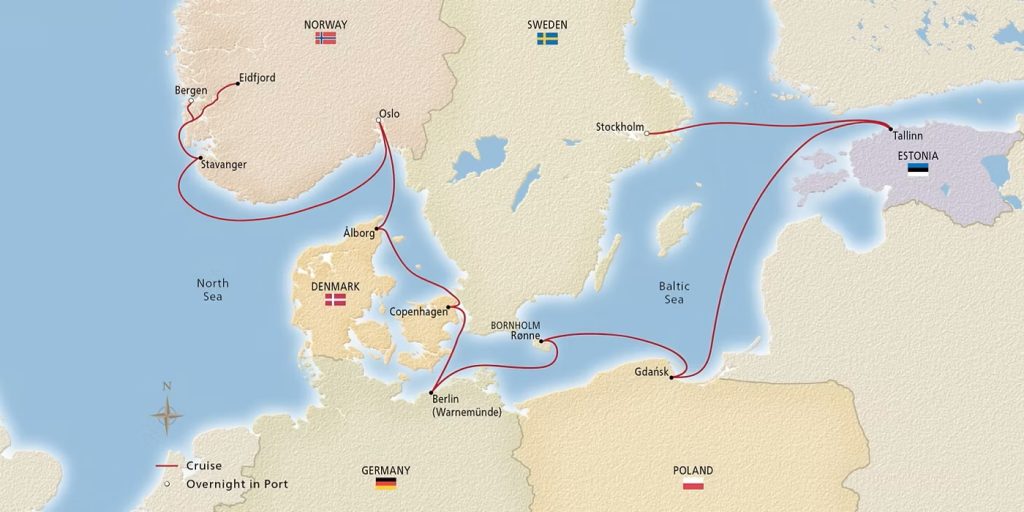
Their Homelands Cruise is a highly rated Scandinavian 15-day itinerary and sails between Bergen, Norway and Stockholm, Sweden. It deeply explores the Norwegian fjords before crossing the Baltic Sea to hit major cultural capitals like Copenhagen, Tallinn, Gdańsk, Oslo, as well as other ports Bornholm (Denmark), Berlin Warnemünde (Germany), Ålborg, (Denmark), Stavanger, Eidfjord and Bergen (Norway).
We arrived at Stockholm Airport from Copenhagen and caught a Bolt taxi ride directly to the Port. Embarking was quick and efficient and we were in our Veranda stateroom in no time. All staterooms on the ship have private balconies (there are no internal cabins) and have a minimalist Scandinavian design. The bathrooms are best-in-class and the heated floors are an absolute treat! The ship remains in Port overnight which is Day 1. A brief outline of the daily cruise experience is as follows:-
Day 2. Stockholm Old Town walking excursion. Unfortunately, the weather was cold and showy, so this wasn’t the day to showcase the old town. We weren’t too bothered as we were scheduled to return for 3 days after the cruise for Geoffrey’s marathon. We didn’t spend much time with the guide and quickly looked for a coffee shop and then the return shuttle back to the ship!
Day 6. Bornholm (Rønne), Denmark. This was a coach tour with an ex-pat American guide who also filled us in on her most-interesting experience in living in Denmark. We had a perfect day and the island showed it beauty to full effect. Who wouldn’t want to live and retire here (except for the horrendous short winter days!
Day 7. Berlin (Warnemünde), Germany. Viking charters a train to take us into the heart of Berlin where we’re free to spend the time as we wish. Unfortunately, it was a Sunday and all the shops were closed. Geoffrey & I have been to Berlin many times so we messaged Geoffrey’s nephew Tom who lives here and met him for a catch up Yum Char lunch!
Day 8. Copenhagen, Denmark. We had spent 2 full days here prior to the cruise so a repeat destination, but the day was perfect and the local guide was interesting and we learnt a lot about the city.
Day 9. Ålborg, Denmark. This was one of the quietest excursions with the highlight being the local Viking market where the locals but on a “Viking” performance and where we sampled the traditional sweets and beverage.
Day 3. Tallinn Old Town, Estonia walking excursion. With a better day we were able to appreciate this excursion and it was really interesting walking through the charming streets which included great vantage points overlooking the town.
Day 4. Baltic Sea Day. The only full sea day on the cruise.
Day 5. Gdańsk, Poland. Another restored Old Town, quite expensive (especially the amber jewellery) and touristy. Viking supply a long-range, portable, wireless audio transmitter system called a Quiet ox which means that you can totally lose the guide and tour group – but rather frustratingly, still hear what they’re saying perfectly through the headphones!
Day 10 / 11. Oslo, Norway. Oslo is probably the most vibrant city in Scandinavia, and we really enjoyed out stay here and it was a good change from the Ancient Towns we were tending to see. The coach tour was excellent including the huge Vigeland Park – home to the 200-plus stone and bronze sculptures depicting the human life cycle. Other highlights included the Oslo Opera House, Nobel Peace Center, the Royal Palace and the Parliament building and Holmenkollen – home to the world-famous ski jump set atop the city’s most prominent hill. We spent time inside the Oslo Opera House and the Munch Museum. Several other notable museums celebrate Oslo’s cultural treasures; perhaps the most renowned, the National Museum, is home to the largest collection of public paintings in Scandinavia. We viewed a number of famous works by Edvard Munch including ‘The Scream’ – considered one of the top 5 most famous and recognizable paintings in human history.
Day 12. Stavanger, Norway. This was probably the most interesting and best preserved of the old towns we saw. The walking tour started through Old Stavanger – a collection of 250 wooden buildings which were saved from demolition in the 1950’s. The Norwegian Petroleum Museum is a fascinating record of exhibits about geology, technology and harnessing the power of oil, which after the discovery of he North Sea field in 1969, transformed Norway reliant heavily on fishing and shipping into one of the wealthiest, most financially stable nations on Earth. There is especially a sobering, deeply moving exhibit dedicated to the 1980 Alexander L. Kielland platform collapse, which killed 123 workers.
Day 13. Eidfjord, Norway. This was our only paid excursion where we elected the Voss, Geilo & Bergen Railway trip. Unfortunately the weather wasn’t the greatest and Geoffrey was uncomfortable on the coach due to a lack of rest stops! Many of the views were obscured by the mist and fog but the Hardangervidda mountain plateau was impressive – especially the Vøringsfossen, which is widely celebrated as Norway’s most famous waterfall. We will remember the nearby Fossli Hotel though for it’s hugely inflated powder hot chocolate beverage!
Day 14/15. Bergen, Norway. The ship docks at Bryggen wharf which is a UNESCO World Heritage Site due to its timbered Hanseatic warehouses and narrow wooden walkways which are flanked by parallel rows of small, vibrantly painted buildings overlooking the picturesque Vågen Harbor. It’s touristy but absolutely quaint and the perfect gateway to the Norwegian fjords.
Please contact me if you are interested in knowing more about anything related to this destination.